
the industrial doctorate plan
What is an industrial doctoral project?
modalities
project
requirements
and procedure
the industrial doctorate plan
The Industrial Doctorates Plan is a public initiative of the Generalitat de Catalunya, promoted at the end of 2012, in collaboration with the Catalan university and research system, closely related to doctoral training, knowledge transfer and the development of R&D&I projects in collaboration with the socio-economic environment – companies and institutions. In this sense, during this decade, the Industrial Doctorates have proactively promoted strategic, collaborative and applied research in Catalonia, and with a return to its society.
- Strategic, because the socioeconomic environment, formed by companies and institutions, has a long-term vision and wants to contribute to the economic and social development of the country, facing a challenge that currently has no answer;
- Collaborative, because this strategic challenge of the socio-economic environment is responded to through collaboration with a university or research center, making its knowledge and the infrastructures of the academic environment available;
- Applied, because it is research close to the current or future needs of society, and that is why, ultimately, it has a return to the society that shapes it.
The Industrial Doctorate Plan has as an essential element the industrial doctorate project : a strategic research project of a company or institution that must be developed in collaboration with a Catalan university or research center, and which will become the object of a doctoral thesis that will allow a doctoral student to acquire the training that will allow him or her to begin a research career in a dual environment: business and academic. These projects aim to respond to the challenges that the socio-economic fabric has identified as strategic for the coming years and that require the expert and specialized knowledge of the research groups to be able to face them with guarantees of success.
Industrial doctoral students, future industrial doctors, therefore act as knowledge transfer bridges , contributing to strengthening the relationships between both environments, the socio-economic and the academic. These people, thanks to the training and experience accumulated during the research and doctoral training project, are the ones who will become key – in other words, they will become a necessary strategic asset – for the economic and social development of Catalonia.
A plan for everyone and for everyone
What is an industrial doctorate?
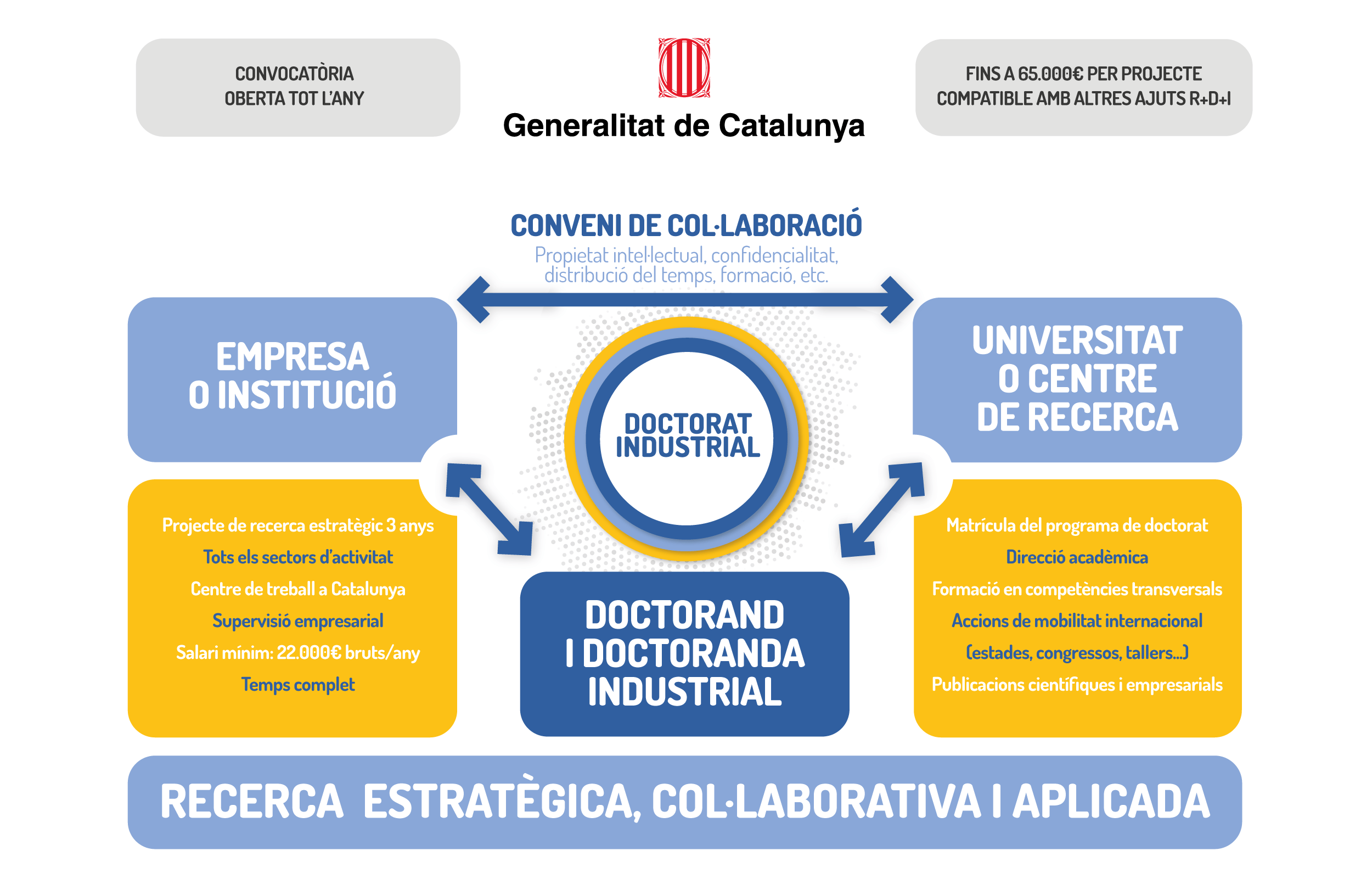
The essential element of the industrial doctorate process is the research project of the company or institution in which the doctoral student develops their research training, in collaboration with a university or research center, and which is the subject of a doctoral thesis.
Industrial doctors thus act as knowledge transfer bridges and contribute to strengthening relationships between the industrial fabric of Catalonia and universities and research centers.
The objective of the Industrial Doctorate Plan is to contribute to the competitiveness and internationalization of Catalan industry , strengthen the instruments to capture the talent generated by the country and place future doctors in a position to develop R&D&I projects in a company.
project types
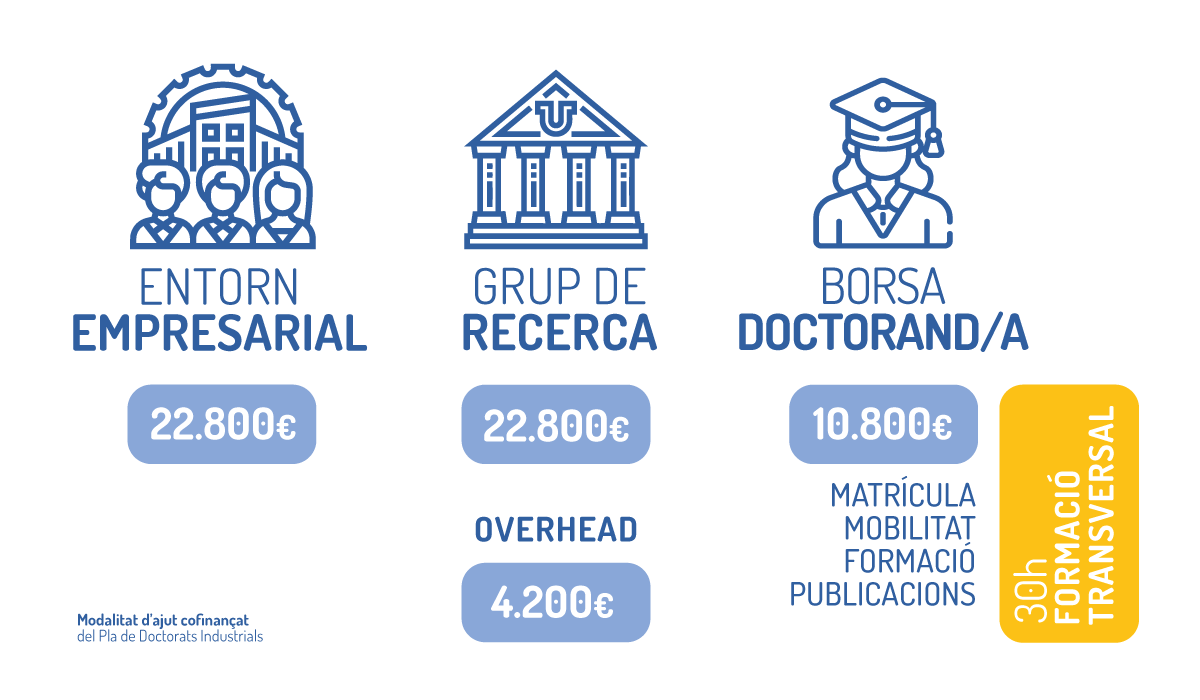
co-financed aid (DI-COF)
Specific Aid (DI-ESP)
The work center of the business environment may or may not be located in Catalonia . It does not require the doctoral student to dedicate himself exclusively to the research project.
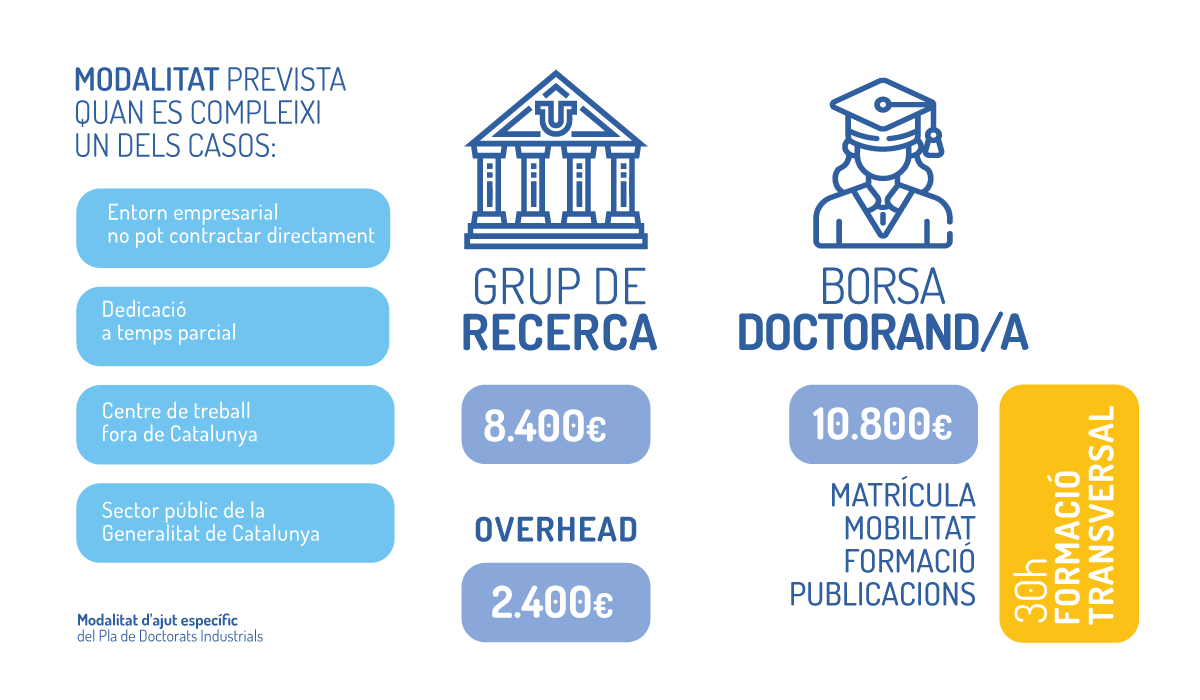
IN BOTH MODALITIES:
They are eligible:
- Private companies and public commercial companies belonging to or linked to the public sector.
- Non-profit foundations and associations, entities belonging to the local , regional or central public sector, consortia with majority public participation and town halls.
- Public Sector entities of the Generalitat de Catalunya , in the specific aid modality.
Excluded:
- Research organizations and their dependent entities.
- The centers attached to universities.
requirements
companies and institutions
- The company or institution must designate a person responsible for the industrial doctoral project, who must have sufficient training and experience for the correct supervision of the doctoral student.
- The company or institution must employ the doctoral student, according to current labor legislation, with a minimum gross salary of 22,000 euros gross per year and the corresponding employer contributions.
Academic environment (universities and research centers)
- The thesis director must be a member of a research group currently recognized by the Generalitat de Catalunya, or be a researcher in the ICREA program or have obtained funding from the European Research Council (ERC).
Future students industrial doctorate
- Comply with the profile defined by the parties to the project (academic training, professional experience, knowledge of languages and other requirements).
- Weighted average grade of the studies that give access to the doctorate, according to current legislation, equal to or greater than 6.50.
procedure
companies and institutions
- Download the project proposal form and fill in all the information regarding the parties participating in the project, as well as the required profile of the candidate.
- Send it, both digitally signed and in editable format (without signatures), to the email address doctorats.industrials.recerca@gencat.cat
- The DI Plan team will publish it in the Projects section of the website for a minimum period of 5 working days for the reception of candidacies from interested persons. After this period, the parties involved must request the closure of the period for the reception of candidacies. The parties will need to evaluate all the candidacies received.
- Apply for funding for an industrial doctoral project at the Virtual Procedures Office of the Generalitat de Catalunya during one of the active call periods. You will need to submit the standard form that you will find in the procedure, following the steps indicated in the procedure, to which the following documentation must be attached:
- Collaboration agreement , which must include, at a minimum, the clauses defined in the regulatory bases of the grant.
- Selection report , in free format and containing the list of candidates interviewed, as well as the summary or selection criteria used for the final decision.
- Document of admission to the doctoral program of the selected candidate.
- Personal academic certificates of the selected candidate from university studies that give access to the doctorate in accordance with current regulations.
- In the event of a favorable resolution of the application, accept the grant in accordance with what is established in the grant’s regulatory bases (base 16).
CANDIDATES FOR DI PROJECTS
- Check out the industrial doctoral project proposals available on the website. You can filter them by university, company or institution and field of knowledge.
- Download the PDF document of the chosen industrial doctoral project proposal, fill in the last two pages with your details, profile and motivation letter and sign electronically.
- Submit your application by sending the electronically signed document to the email address doctorats.industrials.recerca@gencat.cat (it is not necessary to attach your CV or any other additional documentation).
- Once the application has been received, the Industrial Doctorate Plan team will send it to the project manager at the company or institution and to the researcher for assessment.
- The selection process, in any case, is carried out by the company or institution and the university or research center. You will receive any communication or updates directly from the parties involved in the project.