

Xavier Bach Coma’s doctoral research maps shared micromobility in the Barcelona metropolitan area for the first time from an independent perspective. The results question the narrative of private operators and provide scientific criteria for designing more equitable public policies
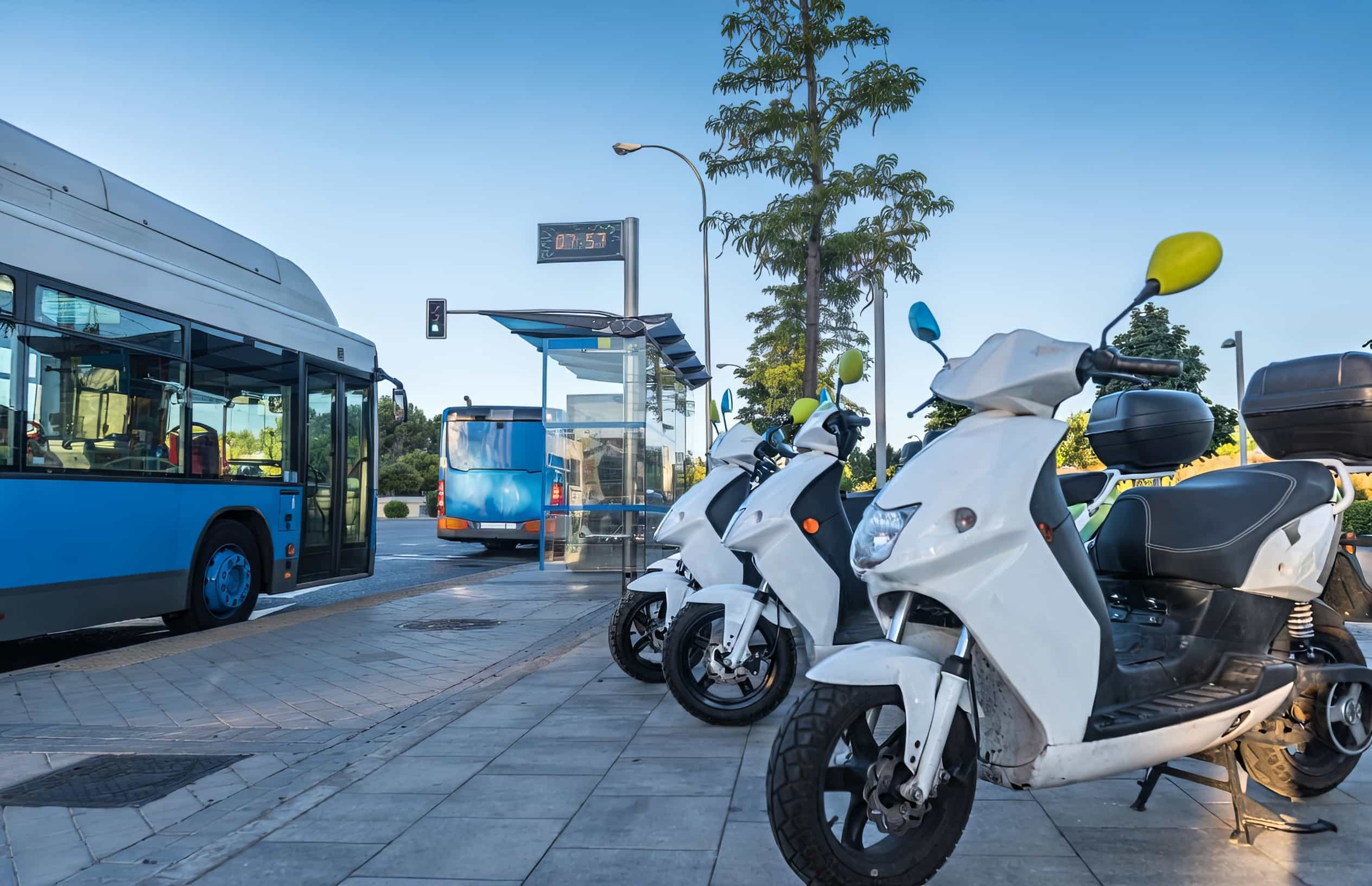
The Industrial Doctorate Plan of the Generalitat de Catalunya promotes applied research projects that connect the research talent of Catalan universities with the real needs of companies and institutions, while solving real problems in society. The project that we present below is a paradigmatic example. It was born from the collaboration between the Department of Geography of the Autonomous University of Barcelona, the Metròpoli Institute and the Metropolitan Area of Barcelona, and addresses one of the most visible, and least understood, transformations that the streets of our cities have experienced in the last decade: the expansion of shared micromobility services.
Electric bicycles without a station, motorbikes rented by the minute, private fleets competing for metropolitan public space. A phenomenon that has grown rapidly, but on which administrations have had to make decisions with very little independent data. Who really uses them? Where do they reach and where do they not reach? Do they replace the private vehicle or simply add to it? Do they contribute to fairer mobility, or do they deepen existing territorial inequalities?
During his industrial doctorate, Xavier Bach Coma has sought rigorous answers to these questions, among others. His doctoral thesis, supervised by Dr. Carme Miralles-Guasch and Dr. Oriol Marquet Sardà, offers for the first time a scientific and neutral diagnosis of shared micromobility in the metropolitan area of Barcelona: who accesses it, how it is integrated into daily travel habits and what criteria should guide its public regulation. The results, published in international academic journals and already incorporated into real metropolitan regulatory frameworks, demonstrate that applied research can guide the mobility policies of the future.

A phenomenon without a map
Barcelona is the European city with the most motorbikes per inhabitant; motorbikes represent 22.2% of the vehicle fleet and 31.8% of daily motorised journeys, according to a study by ICTA-UAB and the Department of Geography of the UAB. It has also been one of the pioneers in public bicycle sharing with Bicing since 2007. On this substrate, a new model of private operation without a fixed station burst in, starting in 2016, led by operators such as Seat Mó, Cityscoot, Cooltra, Yego and Acciona. While private operators defended that their offer was the key to decarbonisation, the urban reality showed a saturation of public space and a lack of neutral data to verify its effectiveness. The result was a fragmented ecosystem: more than ten companies opted for the licenses opened by the Barcelona City Council in 2019, in a process that Bach Coma considers counterproductive: ” everything indicated that this atomization did not benefit either operators or users ,” points out the industrial doctorate.
The research starts from an uncomfortable observation: ” there was no clear discourse on what the role of shared micromobility should be in sustainable mobility policies .” The research set out three main goals: characterizing the real supply and demand of the service, analyzing inequalities in access from a territorial and social perspective, and identifying which regulatory models best guarantee the public interest.
Faced with this gap, Bach Coma’s strategic research set out to achieve three main goals: characterising the real supply and demand of the service, analysing inequalities in access from a territorial and social perspective, and identifying which regulatory models best guarantee the public interest. The main problem lay in the lack of evidence: did these vehicles really replace the private car or simply change the way those who already used public transport moved? This is how the project, with the thesis already defended, not only analyses the operation of these services, but also establishes the roadmap for public regulation that guarantees fair and sustainable mobility.
"Younger generations have more internalized a multimodal way of traveling and do not perceive as much the need to own a vehicle."
Xavier Bach Coma, doctorat industrial (UAB / Institut Metròpoli) Share
How do people who use shared motorbikes really get around?
One of the most relevant results of the thesis against the usual narrative of the operators is the real role of these services in the transport chain. The industry has repeatedly defended that micromobility solves the problem of the “first and last kilometer”, that is, that it complements public transport in those sections that it does not reach. Bach Coma’s research, on the other hand, shows that intermodality is marginal: “it only represents 9.4% in the case of shared bikes and 5.2% in the case of shared motorbikes” , he points out with data from his research.
What is relevant, Bach Coma points out, is its role in multimodality; that is, the fact that a user combines different means of transport throughout the week, without being assigned to any specific one. ” Shared mobility is more multimodal than intermodal” , underlines the industrial doctorate. Shared bicycles show a strong affinity with public transport: 75% of their frequent users also regularly use the metro or bus. Shared motorbikes, on the other hand, present a more hybrid profile: 57% of their regular users also use public transport, but 54% combine the service with their own private vehicle. Bach Coma’s research has provided crucial scientific validation in an environment where economic interests often clash with the general interest. Through access to origin and destination data, his thesis has allowed the identification of the highest pressure points on urban space and has dismantled deeply rooted beliefs.
The geography of exclusion
Access to origin-destination data on shared motorbike trips allowed Bach Coma to map territorial inequality. The analysis, published in the international academic journal Transport Policy and already cited by 23 scientific articles, concludes that the use of these services follows three structural variables: geographical centrality, income level of the neighbourhood and topography. The more central the area, the higher the income and the less steep the slope, the more intense the demand. Services are therefore concentrated in areas of high income and flat topography, while peripheral areas where public transport is already deficient are systematically excluded.
The conclusion is unequivocal: the service does not reach where public transport does not, and therefore does not act as a corrector of its shortcomings but rather reinforces them. “Once again, the fact that these services serve the first and last kilometer is denied,” says Bach Coma. Based on this diagnosis, his research estimates the optimal number of vehicles that the metropolis could absorb while guaranteeing that a user would find one within 100 meters, an operational indicator directly useful for regulators.
"Shared micromobility was a phenomenon that broke out in 2016, but there was no clear discourse on what its role should be in sustainable mobility policies."
Xavier Bach Coma, doctorat industrial (UAB / Institut Metròpoli) Share
From the thesis to metropolitan regulation
The strategic value of research lies in its neutrality. Metropolitan administrations such as the Barcelona City Council or the Metropolitan Area must arbitrate between the interests of private operators, pressure on public space and demands for social equity. Bach Coma defends that “the scientific community can contribute values from neutrality” in an area where evaluating the impact of these services on social justice, road safety or environmental sustainability “is not an easy task for the administration”.
In collaboration with the professor of administrative law Marc Tarrés from the University of Barcelona, Bach Coma has published a specific article on models of micromobility regulation, with the aim of identifying which schemes (fully public, public-private or private without regulation) best guarantee social and territorial equity. The technical support of Maite Pérez Pérez, from the Metropolitan Area of Barcelona, and Núria Pérez Sans, from the Metròpoli Institute, was decisive in articulating the connection between the demands of academic research and the real needs of the public institutions responsible for metropolitan mobility. The metropolitan regulation of shared motorbikes, which already incorporates equity criteria, is one of the tangible results of this process.
The success of this Industrial Doctorate is not measured only in the academic field, but in its direct application in the territory. The equity criteria derived from this research have already been integrated into the regulation of metropolitan shared motorbikes, ensuring that the service is not only economically viable, but also socially fair.
A generational horizon
The future of mobility in Barcelona seems to be going through a generational change. Younger cohorts no longer perceive the need to own a vehicle, prioritizing the flexibility of the service. The fundamental question of Bach Coma’s research was whether shared micromobility can contribute to reducing dependence on the private vehicle in a metropolis of European scale. Bach Coma’s answer is nuanced. “The younger generations, who since childhood have mainly moved around using public transport or shared mobility, have more internalized a multimodal way of moving around and do not perceive the need to own a vehicle.” On the other hand, generations that have grown up with their own car or motorbike show more resistance to changing habits. According to Bach, to consolidate this model ” it is essential to maintain an open mindset and adapt the tempos of the academy to the needs of public institutions.”
This bridge between scientific data and public policy is what will allow, in the next five years, micromobility to stop being a source of conflict and become a real ally of metropolitan sustainability.

