

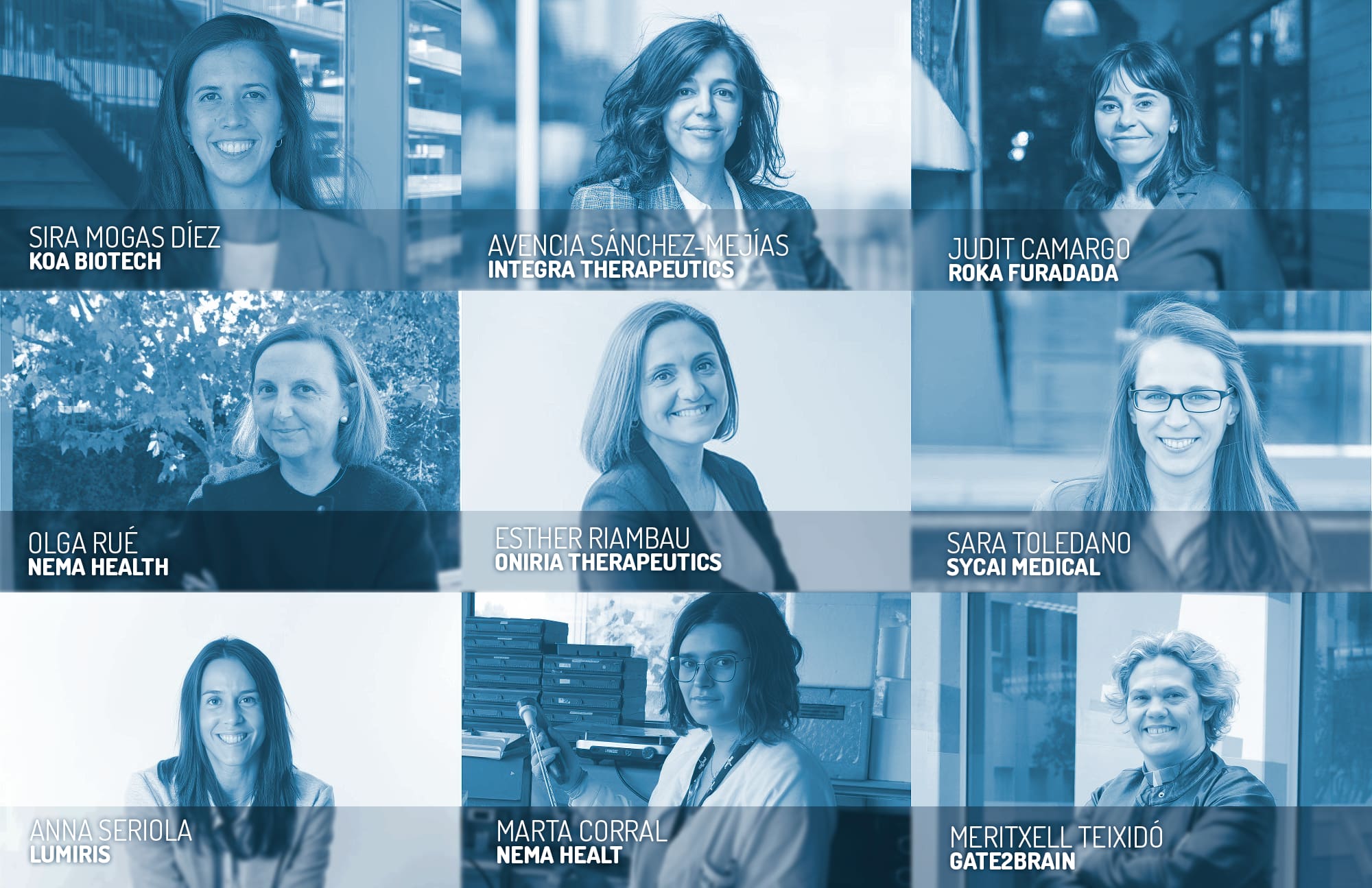
Recently, the newspaper El Periódico has focused on the Catalan Deep Tech ecosystem with the report "16 women at the forefront of the technology of the future". From the Industrial Doctorate Plan (DI Plan) we have analyzed the data and the result is that 9 of these 16 leaders have trusted the DI Plan as a driving force to accelerate their research and bring innovation to the market. This article includes their profiles and projects, and highlights initiatives such as the "Female Triplets", which highlight research teams formed entirely by women.
The presence of women in the founding and leadership of technology companies, especially in the Deep Tech sector, is a key indicator of the health and future of our Catalan innovation ecosystem. Recently, the newspaper El Periódico published the report ” 16 women at the forefront of technology of the future “, which highlights that 32% of advanced technology start-ups in Catalonia are already co-founded by women. As the journalist in the El Periódico article, Paula Clemente , defines it, ” more than ten points higher than average. The same goes for the proportion of companies that have at least one woman in the front line, whether as a project promoter or in the management team. They are 42%, practically half. ” This radiography is based on data collected by ACCIÓ, the agency for the competitiveness of the company of the Generalitat de Catalunya. The confluence between ACCIÓ’s analysis and the reality of the projects of the Industrial Doctorates Plan reinforces the Government’s comprehensive strategy : working in coordination from all areas to promote the Deep Tech ecosystem, applied research and make female leadership visible.
Within this group of co-founders and CEOs of ‘start-ups’ that the Generalitat highlights for their medical or technical potential, there is a fact that makes us especially proud: of the 16 women highlighted for their disruptive impact, 9 lead projects linked to the Industrial Doctorate Plan (DI Plan ). This fact is not a coincidence, but rather the demonstration that the DI Plan has consolidated itself as an ideal knowledge transfer engine for these companies. This effectiveness is not just a perception, but a reality contrasted by the ecosystem and the data. While industrial leaders such as Laura Carnicero (SEAT & CUPRA) define the industrial doctorate as the ” ideal match ” between real challenges and talent, the impact assessment of the program corroborates its solidity: three out of four doctors continue in the company, 21% of projects generate patents and more than 60% of the pairs maintain the collaboration once the thesis is completed. Figures that certify the DI Plan as a fully consolidated program at the intersection between research and the market.
These ‘start-ups’ , based on complex science and advanced engineering, require agile mechanisms to convert frontier research into tangible market solutions, with an impact on society. In this context, industrial doctorates act as a transfer mechanism in this process, allowing companies to incorporate excellent research talent to solve strategic challenges from within the organization , while maintaining a solid link with the most leading university research groups.
This success is part of an intrinsic commitment of the DI Plan to make visible and promote the role of women in the fields of research and innovation . A clear example of this will is the impetus and growth of the so-called Female Triplets : industrial doctoral projects developed by teams formed entirely by women (the industrial doctoral student, the company manager and the thesis director). This initiative not only challenges gender stereotypes in STEM disciplines, where women are still underrepresented, but also exemplifies how diversity and female leadership enrich research and lead to more creative and effective solutions.
Beyond numbers and statistical parity, the true value of these entrepreneurs is the tangible impact of their research . They are not limited to leading technology companies, they are redefining the scientific frontiers of knowledge to provide answers to urgent global challenges. Thanks to the collaborative framework of the industrial doctorate, these nine leaders have turned academic research into the engine of three great revolutions: the development of advanced therapies for previously intractable diseases, artificial intelligence applied to precision health, and the creation of sustainable solutions to protect our environment.
Next, we discover how each one is transforming the future from the present. Thus, the analysis of these profiles moves away from biographical enumeration to focus on the resolution of the challenge. Below, we break down how this knowledge transfer is articulated in three critical fronts or areas of impact. How these women are solving specific global challenges (health, data technology and sustainability) thanks to collaborative research. While the original report by El Periódico structured these leaderships under a biographical logic, the perspective of industrial doctorates requires focusing on the underlying science. For this reason, we have considered reorganizing the cases according to their impact vector (health, data and sustainability), highlighting how applied doctoral research is no longer a curricular attribute to become the solution to society’s challenges.
At the forefront of new therapies, fighting cancer and hereditary diseases
The largest group of these entrepreneurs is redefining biomedicine with the aim of curing diseases that currently have limited treatments. The DI Plan acts here as a lever to accelerate the transition from the laboratory to the clinic.
In the field of oncology, Meritxell Teixidó , CEO of Gate2Brain, leads a spin-off that aims to overcome biological barriers. Her industrial doctorate , in collaboration with the Hospital Sant Joan de Déu, focuses on pediatric oncology: they use shuttle peptides to cross the blood-brain barrier and transport drugs directly to childhood brain tumors, improving their efficacy and reducing side effects. The complexity of this challenge is analyzed in depth in a report on the project published by Pla DI, while the scientific execution is detailed in a recent interview with Clàudia Resa, the industrial doctor who led the research.
Also in the fight against cancer, Esther Riambau of Oniria Therapeutics , a company with three industrial doctorate projects and recognized in 2024 by ACCIÓ as the most disruptive in Catalonia, attacks resistance to treatments. Her research focuses on modulating the epigenetic enzyme TET2 to “awaken” and eliminate persistent tumor cells that survive chemotherapy and cause relapses. For her part, the tandem formed by Olga Rué (CEO) and Marta Corral (CSO) at Nema Health is committed to immunotherapy. Their project ” Onconeovac ” seeks to validate a therapeutic vaccine based on a specific peptide (DIF-P) to treat metastatic melanoma, activating the patient’s immune system when other options fail. Finally, in the field of gene editing, Avencia Sánchez-Mejías , co-founder of Integra Therapeutics together with ICREA doctor Marc Güell, uses the industrial doctorate to perfect genetic writing tools. His project integrates genetic engineering, computational biology and machine learning to design new proteins that allow genes to be cut and pasted with maximum precision, opening the door to curing hereditary diseases .
The data revolution: Artificial intelligence and imaging for diagnosis
Technology and the massive use of data are the common denominator of these leaders who seek to maximize diagnostic accuracy and transcend the thresholds of human perception. First, Sara Toledano of Sycai Technologies applies engineering to medical diagnosis. Her industrial doctoral project trains Deep Learning algorithms to “clean” abdominal CT and MRI images, eliminating visual errors and allowing early and accurate detection of cancerous lesions in the pancreas or liver. In the field of reproductive health, Anna Seriola is the co-founder and CEO of Lumiris, the company that drives the HYCELL project in collaboration with the Institute of Bioengineering of Catalonia (IBEC) – University of Barcelona. Using hyperspectral imaging technology and AI, they analyze the metabolism of embryos and eggs non-invasively to improve success in assisted reproduction, and explore new methods to diagnose endometriosis through menstrual blood.
Smart solutions for the environment and people
The innovation of these entrepreneurs also addresses sustainability, from skin protection to food safety. In this area, we highlight Judit Camargo de Roka Furadada , whose success story we recently analyzed in an interview , CEO of a company that has turned the industrial doctorate into a key piece of its R&D department to revolutionize photoprotection. Her projects develop encapsulated sunscreens that are activated by radiation (“progressive filters”) and investigate the use of plant lignin to create biobased cosmetics, thus reducing toxicity to humans and the impact on marine ecosystems. At the same time, Sira Mogas , CEO and founder of KOA Biotech ( a spin-off of UPF) brings technology to the water. Their project designs IoT sensors to monitor pathogens in fish farms in real time, allowing producers to anticipate infectious outbreaks, reduce fish mortality and decrease the use of antibiotics in the food chain.
In conclusion, the trajectory of these nine entrepreneurs shows that female leadership is not a promise of the future, but a reality that is already transforming critical sectors such as biomedicine, sustainability and artificial intelligence. From the Industrial Doctorate Plan, we reaffirm our commitment to continue being the bridge that connects this talent with academic excellence and market needs.
Promoting the presence of women in scientific and business leadership roles, as exemplified by these 9 founders and the Female Triplets teams, is not just a matter of equity. It is an indispensable country strategy to enrich research with new perspectives, accelerate knowledge transfer, and ensure that the technology of the future is designed with a plural and inclusive vision.
